

23 Sep Intramedullary Nails vs. External Fixators: Comparing Methods
Before internal lengthening nails became widely available, external fixation was the standard method for limb lengthening, and it’s still used today in certain cases. Understanding how the two approaches compare helps explain why internal nails have become the preferred option for most patients, and why external fixators still have a role.
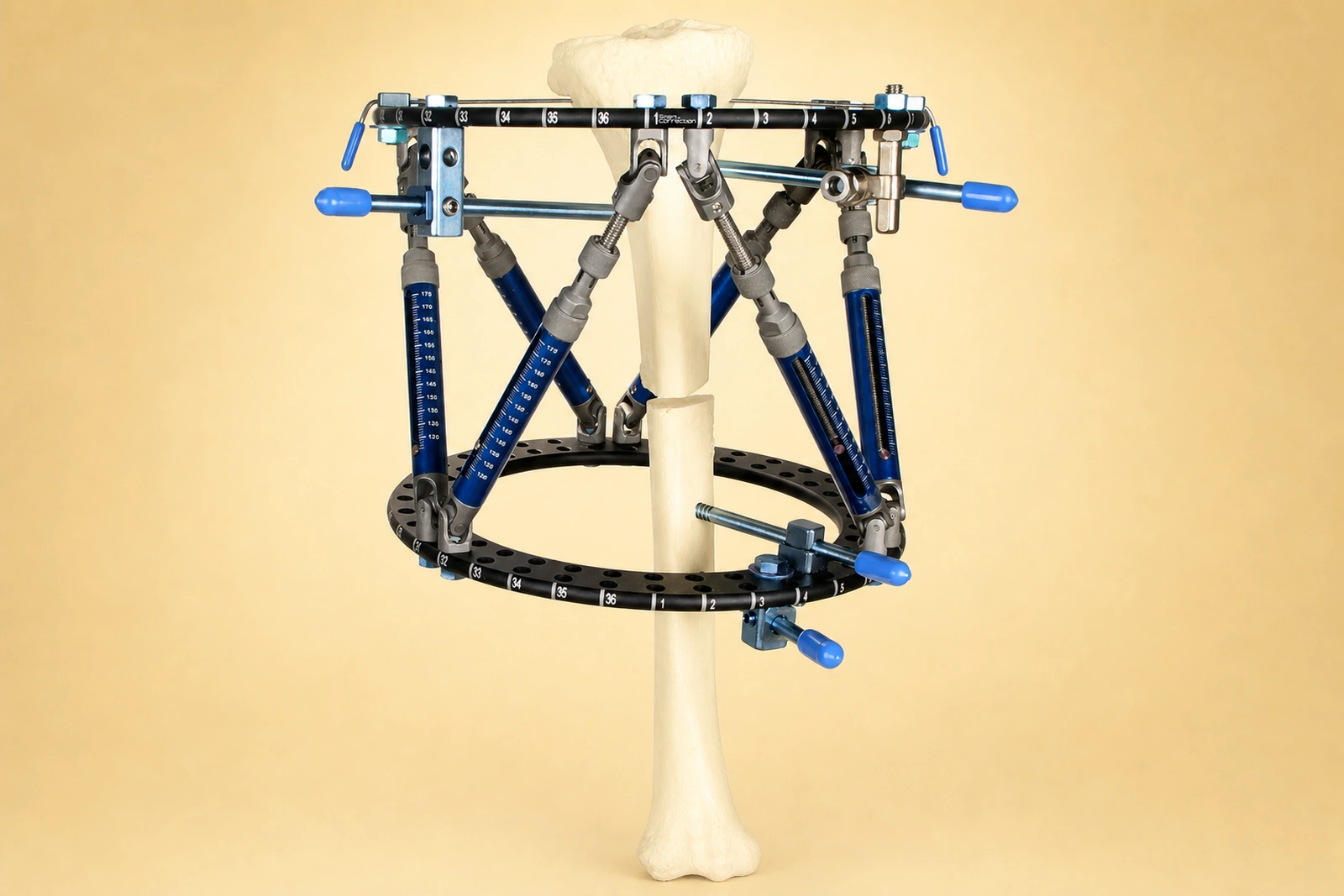
An external fixator is a frame of metal rings or rails positioned outside the leg, connected to the bone by pins or wires that pass through the skin and into the bone itself. Lengthening is achieved by adjusting struts or rods on the external frame, gradually pulling the bone apart at the surgical cut site. This method has a long track record and offers a high degree of control, including the ability to correct angular deformities and rotation at the same time as lengthening — which makes it especially useful for complex deformity cases, not just straightforward lengthening.
The trade-off is that the frame is worn externally for the entire duration of treatment, often several months. Because pins pass through the skin, there’s an ongoing responsibility for pin-site care, and a meaningfully higher risk of pin-site infections compared to internal methods. The external hardware is also more visually apparent and can be more cumbersome in daily life, clothing, and sleep.
Internal lengthening nails address many of these drawbacks. Because the device sits entirely inside the bone, there are no external pins, no visible frame, and a substantially lower infection risk. Patients generally report a more comfortable day-to-day experience and find it easier to return to normal clothing and social activities during treatment. The trade-off is that internal nails offer less ability to simultaneously correct significant angular or rotational deformity compared to an external frame, so they’re best suited to relatively straightforward lengthening rather than complex multi-plane deformity correction.
In practice, many surgeons now default to internal nails for straightforward cosmetic or LLD lengthening, reserving external fixation for cases involving significant angular deformity, very young patients, prior infection, or situations where the bone anatomy makes internal nail placement difficult. The right method is a case-by-case surgical decision based on imaging and the specific deformity or lengthening goal.
This article is for general educational purposes only and does not constitute medical advice. Every patient’s anatomy, goals, and treatment plan are different. Please consult a qualified orthopedic surgeon to discuss whether any procedure described here is appropriate for you.